
Instant Pot Hacks
The Instant Pot already feels like the ultimate kitchen hack to me: put a bunch of ingredients into the pot, lock the lid, push a few buttons, then walk away. Come back in less than an hour to perfectly cooked grains, a steamy thick soup, or maybe an elegant rice pudding.
Can a kitchen hack be further hacked? Well, I guess so. I hope so, anyway, because I have four favorite hacks that go beyond conventional Instant Pot use and make pressure cooking even more fun.
Zero-Minute Steamed Vegetables
Proofing Bread or Pizza Dough
Deodorizing the Sealing Ring
Pot-in-Pot Method
Zero-Minute Steamed Vegetables
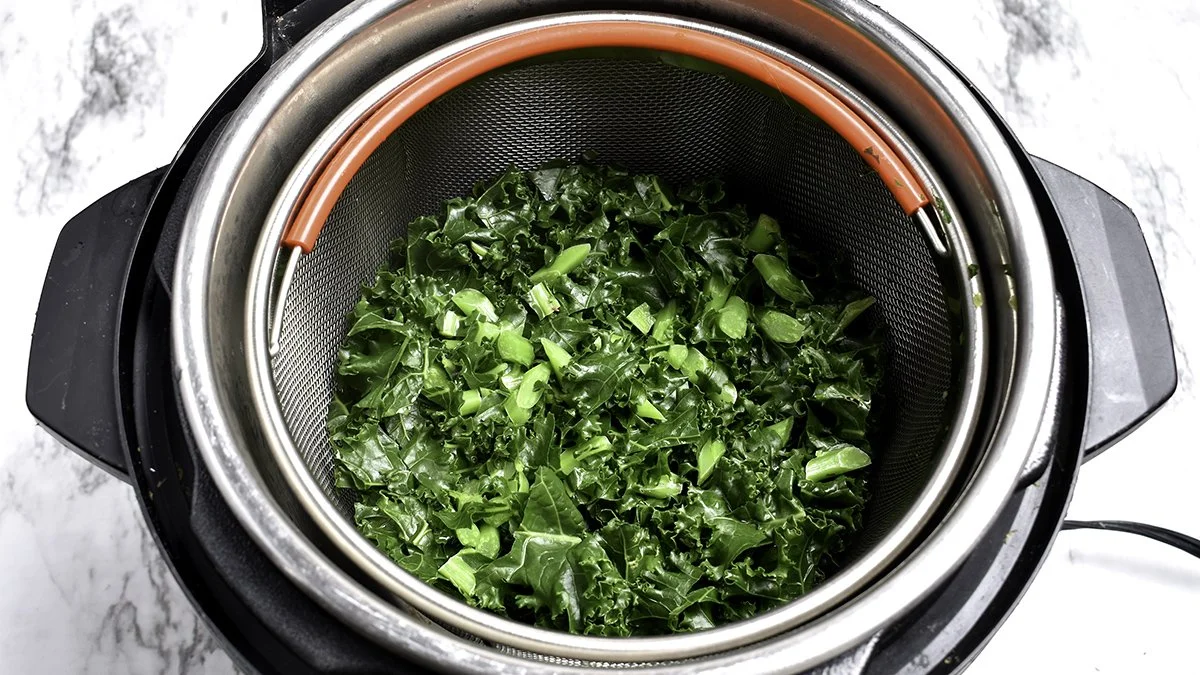
Kale steamed with the Zero-Minute steam method
If you’re like me, you steam a lot of kale, broccoli, cauliflower, and other sturdy vegetables to get your dark leafies and cruciferous vegetables every day. I use my Instant Pot to make it easy. Just the preheat phase is enough to cook most of these vegetables. They don’t need any time at high pressure. It’s fast and simple.
I learned about this approach from Dr. Greger. I’ve written up the exact method I use in this blog and in the second chapter of my Plant-Based Anti-Inflammatory Cookbook.
Proofing Bread Dough
Over the years I’ve tried all sorts of way to proof bread and pizza dough: a warm dishwasher, a slightly preheated oven, a pilot light (back in the day when stoves had pilot lights), and my current makeshift proofing box involving a plastic storage container, an electric heating pad, and a plug-in thermostat. Using the Instant Pot is a more elegant solution. You can use the Low Yogurt function (if you have that option) or the "Keep Warm" function to create a warm, humid environment for yeast-based doughs to rise.
How to Proof Dough With the “Low” Yogurt Setting
Don’t use this approach if you don’t have the option of high or low for your “Yogurt” setting, which is my situation. Otherwise, it’s too hot for the dough. Lightly grease the inner pot and put the dough on the bottom, or place a bowl on the trivet and put your dough in there. Twist on the Instant Pot lid with the knob turned to “Venting” or use a glass lid or plate.
Select the Yogurt function and adjust to the "Less" or "Low" setting. Minutes will be variable depending on your dough. Check after 30 minutes and go from there.
How to Proof Dough With the “Keep Warm” Setting
Don’t add the dough at first. Put the lid on and turn on “Keep Warm” for 8 minutes, then turn OFF.
After preheating, lightly grease the inner pot and put the dough on the bottom, or place a bowl on the trivet and put your dough in there. Twist on the Instant Pot lid with the knob turned to “Venting” or use a glass lid or plate.
Check the dough after 30 minutes. Leave it longer as necessary. The residual heat should be enough to last for the entire proofing time.
Deodorizing the Sealing Ring
Many people are concerned that the silicone sealing ring in the Instant Pot lid can take on the odor of dishes that are well spiced, like curries or chili. I have never tasted a strange leftover flavor after making these dishes, but for those who want to get rid of the odor, you can use the Instant Pot to deodorize the ring.
How to Deodorize the Sealing Ring
Remove the sealing ring from the lid. Place the ring into the inner pot with 1 cup of white vinegar and 1 cup of water. Twist on the lid (it won’t have a seal, but it will still work). Run the “Steam” function for 2 minutes. Quickly release the steam and open the lid. Carefully remove the hot ring and air it dry.
Pot-in-Pot (PiP) Method
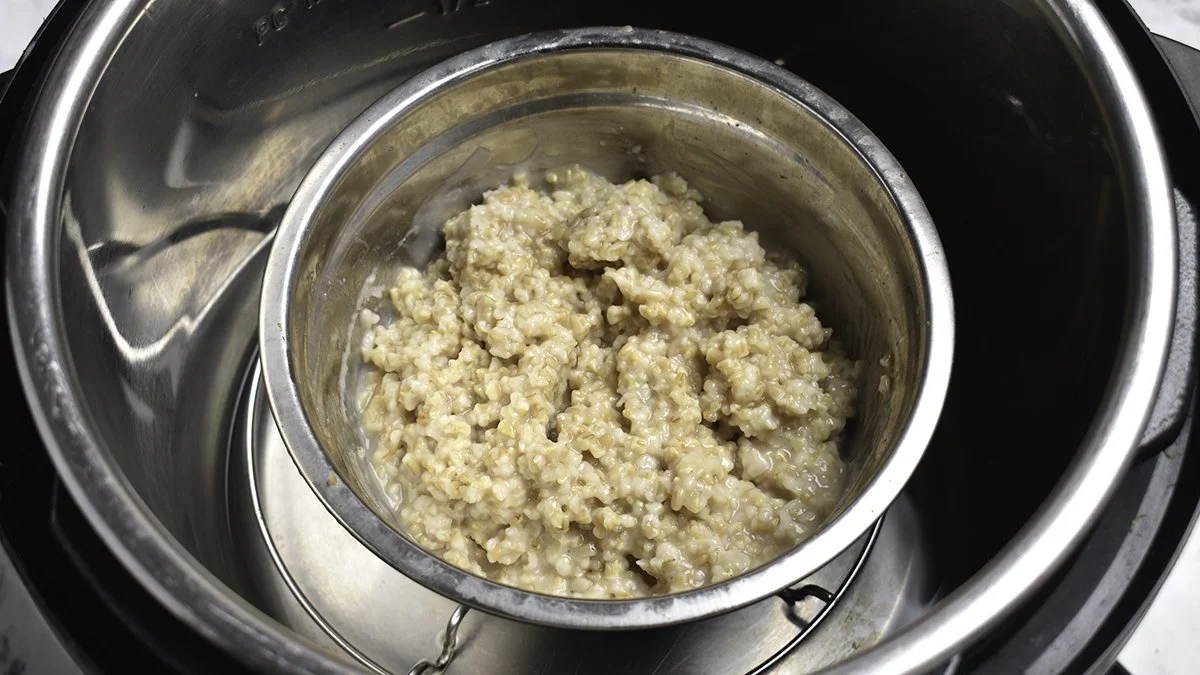
Small-batch steel-cut oats made with the PiP method
The PiP method remedies some of the slight inconveniences of Instant Pot cooking. I say “slight” because these are not deal-breakers for me, but the PiP approach does help in a number of circumstances, especially if you’re looking for smaller portions.
Here are the main tricks the PiP method performs.
Cooking small batches
Cooking multiple dishes together at the same time
Preventing the BURN alert
Make a cake!
The first thing you have to do to use the PiP method is find a pot of some sort that will fit in the Instant Pot. It can be made of metal, glass, or ceramic. (I have seen warnings about using Pyrex, so I am choosing not to use it.) I didn’t have a suitable container to use for the PiP method because all my metal and ceramic bowls were too wide (the container needs to be 7 inches or less in diameter). Metal heats up the fastest with the PiP method, so I studied the capacities and dimensions of the metal bowls available on Amazon. I ended up buying this bowl. It accommodates 4 cups without taking up too much space in the Instant Pot. If you want to cook two dishes at the same time, you’ll also need a trivet rack with 2- or 3-inch legs. I bought this set of two. You can also use ramekins for multiple small batches.
Basic Instructions for the Pot-in-Pot Method
The foundational method for PiP is similar to steaming in the Instant Pot.
Add water: Pour the 1–1½ cups (for a 6-quart model) into the main stainless steel inner pot.
Use the trivet: Place the trivet (the metal rack that came with your Instant Pot) inside the inner pot, sitting in the water.
Place the bowl: Place your food inside the oven-safe container (in my case, the metal bowl) and then set the bowl directly on top of the trivet. (For some applications you may need to cover the bowl with foil.)
Cook: Twist on the Instant Pot lid and cook as directed.
Small batches
Sometimes you don’t want to make a lot of grains, and you don’t want to clean the big pot. The PiP method lets you make a few servings of a dish even in a 6-quart or 9-quart Instant Pot. Here are a few small batches that work well.
PiP Steel-Cut Oats (2 servings)
Add 1½ cups of water into the bottom of the Instant Pot inner pot. Insert your trivet rack. Add the following ingredients to your PiP bowl.
½ cup steel-cut oats
1½ cups water (or plant-based milk for a thicker and creamier consistency, or a milk-water combination)
Place the PiP bowl on the trivet in the Instant Pot. Lock the lid. Set the knob to “Sealing.” Program for 8 minutes at high pressure. When the cooking is complete, allow the pressure to naturally release for at least 15 minutes (until the pot shows L0:15). Carefully remove the bowl. Stir the oats and serve with your favorite toppings.
Pip Brown Rice (2 servings)
For two servings of brown rice, use the same method as above with the following changes: ½ cup uncooked brown rice and ⅔ cup water. Program the high pressure for 28 minutes and allow the pressure to naturally release for about 15 minutes.
PiP Black Bean Soup (2 servings)
Add 1½ cups of water into the bottom of the Instant Pot inner pot. Insert your trivet rack. Add the following ingredients to your PiP bowl.
1 can (15 ounces) black beans, drained and rinsed
1 cup vegetable broth
½ teaspoon chili powder
½ teaspoon oregano
½ teaspoon onion powder
¼ teaspoon garlic powder
Cover the PiP bowl tightly with aluminum foil or a heat-safe lid. Place the covered PiP bowl on the trivet in the Instant Pot. Lock the lid. Set the knob to “Sealing.” Program for 8 minutes at high pressure. Once done, let it sit for 10 minutes, then vent the remaining steam and open the lid. Add a teaspoon of red wine vinegar or lemon juice, and season with salt and pepper to taste. Mash the soup a bit for added creaminess, if desired.
Multiple dishes with PiP
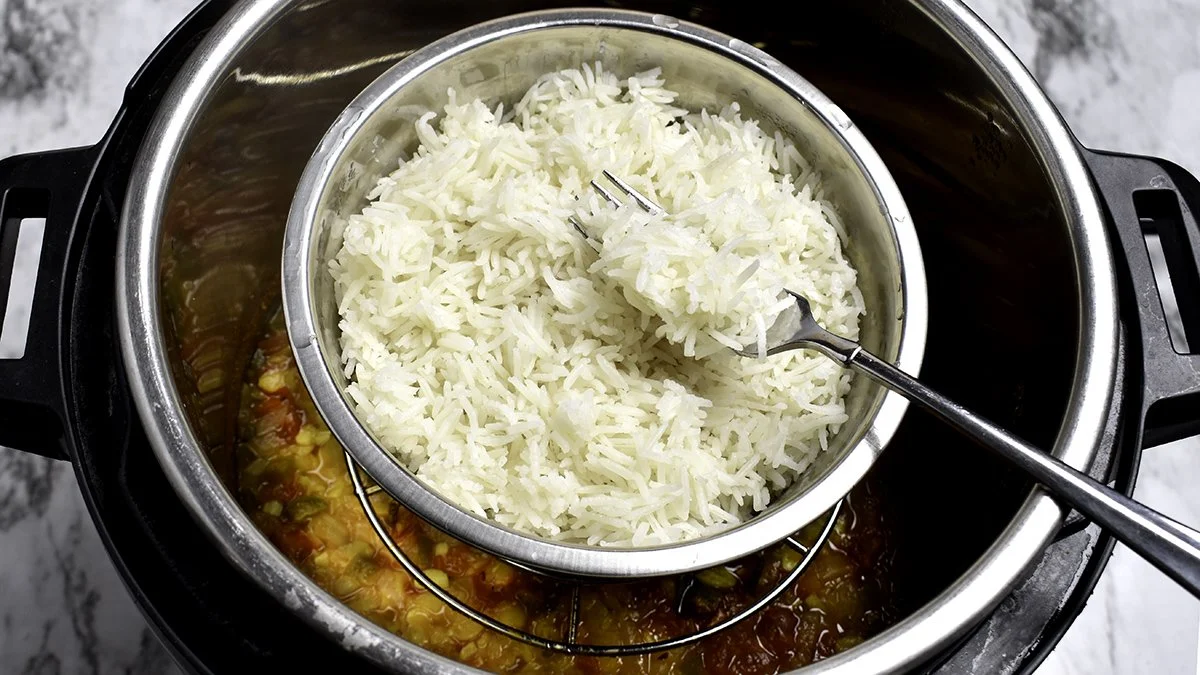
Dal and rice made with the PiP method
Now, this feels like a real hack: making grains or vegetables at the same time and in the same pot as a curry, dal, beans, or soup. The best part is that they’re hot and ready to eat at the same time.
The key to success with multiple dishes is compatible cooking times. For example, brown rice requires significantly more time than quinoa to cook, so the dishes they’re each cooked with need to be different. Here are general guidelines for combinations.
For dishes that take 5–10 minutes of high pressure (like many lentil dishes), the best accompaniments to make in the pot-in-pot are quinoa, jasmine rice, basmati rice, green beans, zucchini, broccoli, cauliflower, and carrots.
For dishes that take 15–25 minutes of high pressure (many kinds of soups and stews), the best accompaniments are white rice, winter squash chunks, whole medium potatoes, and beets.
For foods or dishes that take 30 minutes or more (for example, unsoaked beans), brown rice is an excellent accompaniment to cook in the extra pot.
Instructions are simple. Add all the ingredients of your main dish into the pot, then insert a trivet rack with long legs (2 or 3 inches), then put the supplementary dish in your PiP bowl and set it on the trivet. Add water to the grains: 1 cup water for every 1 cup white rice, 1¼ cups water for every 1 cup brown rice. It’s best to cover the inner small pot with foil to prevent the rice from getting waterlogged by all the steam from the main dish. For vegetables, 1–2 tablespoons water should be added, and it’s not necessary to cover them. After everything is set up, cook the dish according to the directions of the main dish.
Prevent the BURN alert
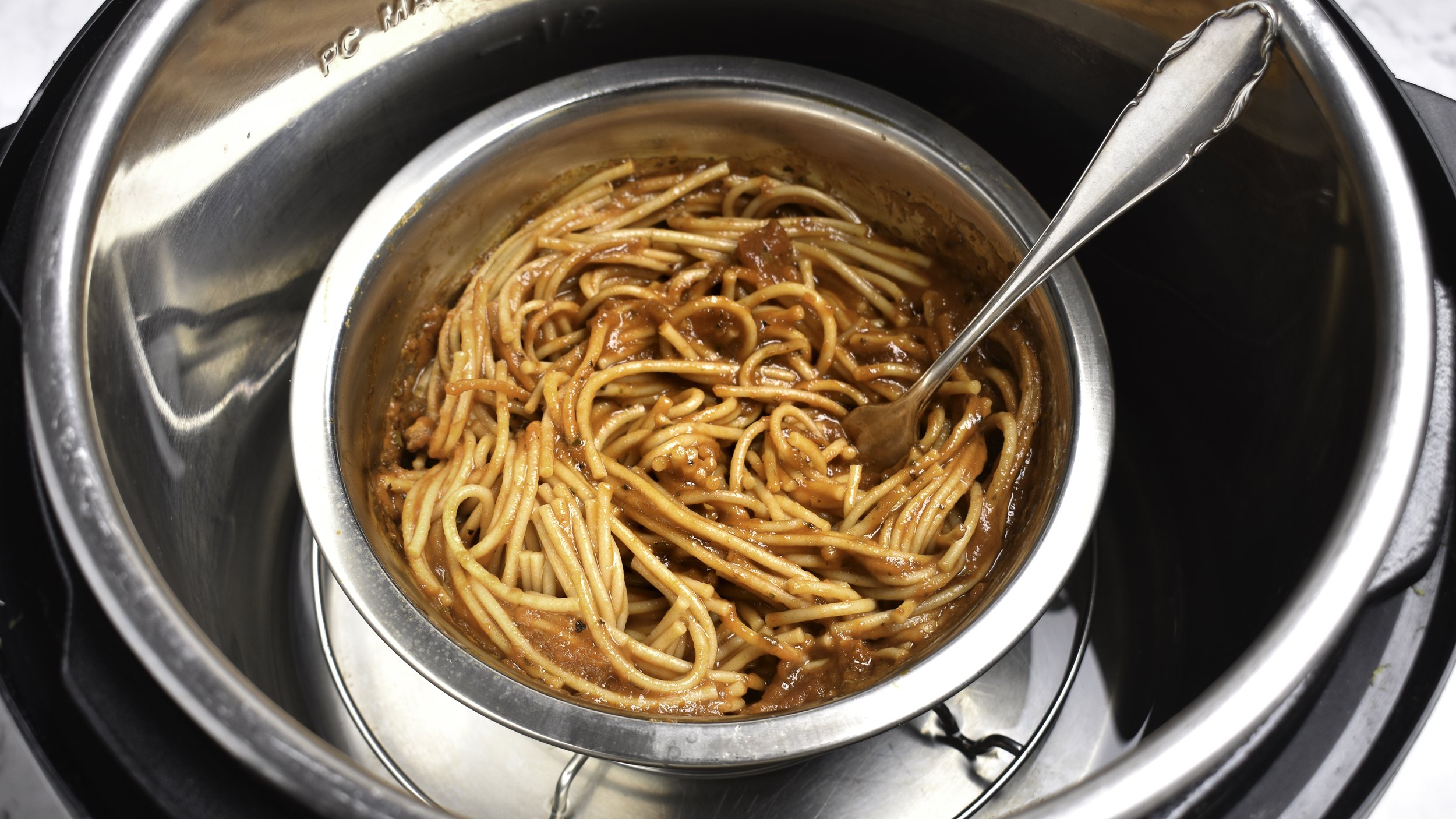
Spaghetti marinara made with the PiP method
If you’ve ever had a BURN alert, you’ll be happy to know that the PiP method could be a game-changer. By making a vulnerable dish in the PiP, where it’s sitting on the trivet rather than the bottom of the Instant Pot, there’s no chance of the BURN alert being triggered as long as you’ve put water in the bottom of the Instant Pot.
Pasta dishes are the most logical for BURN prevention because they don’t have a lot of extra liquid once the basic liquid is soaked up. They also often contain tomato sauce, which is extra vulnerable to burning in the Instant Pot. The one downside is that they take a bit longer with the PiP method.
Here’s a recipe that won’t burn using the PiP method.
PiP Spaghetti Marinara (2 servings)
Add 1½ cups of water into the bottom of the Instant Pot inner pot. Insert your trivet rack. Take your smaller, heat-safe PiP bowl.
Break the 4 ounces of spaghetti into halves or thirds. Place the spaghetti in the bottom of the bowl.
Add ¾ cup of water.
Add an optional ¾–1 cup drained and rinsed chickpeas or other protein.
Pour 1½ cups of marinara sauce over the top. DO NOT STIR.
Cover the PiP bowl tightly with aluminum foil or a heat-safe lid. Place the covered PiP bowl on the trivet in the Instant Pot. Lock the lid. Set the knob to “Sealing.”
Add 5 minutes to the time your spaghetti package says to boil it. That’s the timing to program for high pressure. This works for regular, whole wheat, or legume-based spaghetti.
Once high pressure is done, immediately move the knob to “Venting” and once the steam has vented, open the lid. Carefully remove the bowl, stir the sauce and pasta together, and serve.
Make a cake!
You can even make cakes using the PiP method. You’ll need a 6- or 7-inch cake pan. There aren’t that many recipes available that are healthy, plant-based, and Instant Pot friendly, but here’s a Chocolate Cake recipe by Kim at Simply Planted Based Kitchen. I suspect the method would work with carrot cakes, too (like my Carrot Cupcakes), but I haven’t tested carrot cake in the Instant Pot.
For further reading
There are several excellent other primers on the PiP method, which I link to here.
The Ultimate Guide to Pot-In-Pot Cooking (Piping Pot Curry)
How to Use the Pot in Pot Method in Your Pressure Cooker (Pressure Cooking Today)
Pot in Pot Instant Pot Cooking Guide: All You Need to Know (Amy + Jacky / Pressure Cook Recipes)